Home | MyGov

Accessibility
Accessibility Tools
Color Adjustment
Text Size
Navigation Adjustment
Screen Reader iconScreen Reader

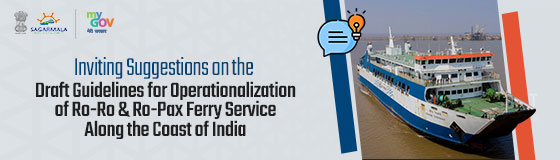
Inviting Suggestions on the Draft Guidelines for Operationalization of Ro-Ro and Ro-Pax ferry service along the coast of India

Inviting Suggestions on the Draft Guidelines for Operationalization of Ro-Ro and Ro-Pax ferry service along the coast of India
Start Date :
Jun 22, 2022
Last Date :
Jul 06, 2022
23:45 PM IST (GMT +5.30 Hrs)
Submission Closed

The Ministry of Ports, Shipping, and Waterways, under the Sagarmala Programme, intends to create an ecosystem for the development of Ro-Ro (Roll-on, Roll-off) ferries and waterway ...

The Ministry of Ports, Shipping, and Waterways, under the Sagarmala Programme, intends to create an ecosystem for the development of Ro-Ro (Roll-on, Roll-off) ferries and waterway transportation throughout the nation. When compared to traditional modes of transportation, this method of transportation offers a number of advantages, including shorter travel distances, cheaper logistics, and less pollution.

The draft guidelines aim to standardise and streamline the development and operation of ferry services, as well as, promote ease of doing business by reducing delays and conflicts, Additionally, guidelines will aid in boosting private players' confidence, hence expanding their involvement and encouraging healthy competition in such ventures.

The draft of Guidelines for Operationalization of Ro-Ro and Ro-Pax ferry service along the coast of India is issued for public consultation for seeking feedback and suggestions.

Click here to read the policy document. (PDF 1,230KB)

The last date of submission is July 6, 2022.

Reset
Showing 859 Submission(s)
SANJAY SARKAR
SANJAY SARKAR 4 years 1 week ago
new regulation requiring indicators on the navigating bridge for all doors which, if left open, could lead to major flooding of a special category space or a ro-ro cargo space, as well as means such as monitoring to detect water leakage.
SANJAY SARKAR
SANJAY SARKAR 4 years 1 week ago
The Maritime Safety Committee (MSC) adopted the first package of amendments to the International Convention for the Safety of Life at Sea (SOLAS) in April 1988,
Rajiv Kumar Pathak
Rajiv Kumar Pathak 4 years 1 week ago
Respected PM Modiji The govt.oppionian is the best for RO-RO & PAX Development.Is is the best for all of Us. It should be mannage by Private sector Agency. Design should be different of any boats. Boat should be looked like an Aeoroplane model With best regards Rajiv Kumar Pathak
SANJAY SARKAR
SANJAY SARKAR 4 years 1 week ago
Shortly after the Herald of Free Enterprise disaster in 1987, the United Kingdom came to IMO with a request that a series of emergency measures by considered for adoption.
SANJAY SARKAR
SANJAY SARKAR 4 years 1 week ago
March 1987 the roll-on/roll-off passenger ferry Herald of Free Enterprise capsized and sank shortly after leaving Zeebrugge in Belgium. The accident occurred because the bow door was left open when the ship left port allowing water to enter and flood the car deck.
SANJAY SARKAR
SANJAY SARKAR 4 years 1 week ago
Until the early 1950s someone wishing to take his car from one country to another by sea had to get it loaded into the ship's hold by crane, a time-consuming and expensive process. The development of the ro-ro car ferry changed all that and many ports boomed as a result.
SANJAY SARKAR
SANJAY SARKAR 4 years 1 week ago
Ro-ros have also proved extremely popular with holiday makers and private car owners and have significantly contributed to the growth of tourism
SANJAY SARKAR
SANJAY SARKAR 4 years 1 week ago
For the shipper, the ro-ro ship offered a number of advantages over traditional ships, notably speed. As the name of the system implies, cars and lorries can drive straight on to a ro-ro ship at one port and off at the port on the other side of the sea within a few minutes of the ship docking.
SANJAY SARKAR
SANJAY SARKAR 4 years 1 week ago
Ships were specially designed to take trains across rivers which were too wide for bridges: the ships were equipped with rails, and the trains simply rolled straight on to the ship, which sailed across the river to another rail berth where the train would roll off again. An example is the Firth of Forth ferry in Scotland which began operations in 1851.