
Home | MyGov

Accessibility
Accessibility Tools
Color Adjustment
Text Size
Navigation Adjustment
Screen Reader iconScreen Reader

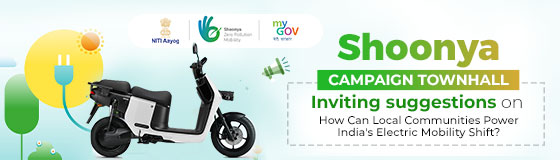
Shoonya Campaign Townhall - Inviting Suggestions On How Can Local Communities Power India's Electric Mobility Swift

Shoonya Campaign Townhall - Inviting Suggestions On How Can Local Communities Power India's Electric Mobility Swift
Start Date :
Feb 13, 2024
Last Date :
Mar 13, 2024
23:45 PM IST (GMT +5.30 Hrs)
Submission Closed

The NITI Aayog-led Shoonya campaign, in partnership with MyGov India, is thrilled to announce the electric vehicles Townhall, an open discussion platform for citizens to share ...

The NITI Aayog-led Shoonya campaign, in partnership with MyGov India, is thrilled to announce the electric vehicles Townhall, an open discussion platform for citizens to share valuable ideas and suggestions to promote and enhance the clean electric mobility ecosystem in India. The Townhall focuses on electric vehicles (EVs) and their associated advantages, including cost savings, clean air, health benefits, and emission reduction.

In line with this initiative, NITI Aayog in collaboration with MyGov, invites input from citizens.

To learn more about the Shoonya Campaign and discover the benefits of EVs, please visit the Shoonya campaign website at www.shoonya.info

Reset
Showing 973 Submission(s)
Rohit Shinde
Rohit Shinde 2 years 4 months ago
India is taking the lead in the global shift to electrification by introducing several electric vehicles or hybrid vehicles. According to market research firm Jato Dynamics, Electric vehicle (EV) sales grew 112% YoY to 50,284 units during April-September 2023. Thus, India has already begun shifting to EVs.
Vijayakumar Jayabal
Vijayakumar Jayabal 2 years 4 months ago
Village level SHG can push EV initiative first by themselves start using EV scooters. Every village office or prominent place such as temple, church, mosque , post office , banks should have atleast one EV charging point (not only in petrol bunk) EV scooters drive demo should happen in every village , right now only in major cities. In village, once people tried their hand , then they opt for sure. EMi with government subsidies will help them to enrol. third, using solar panels across all village house top, will create energy sources in the transmission line
sheo singh
sheo singh 2 years 4 months ago
चीन की तरह छोटी चार पहिया कारो को प्रोत्साहित करना चाहिए . अच्छी डिजाइन हो शहर में काम करने हेतु माइलेज हो तथा अधिक महंगी ना हो।
Chhotu Kumar
Chhotu Kumar 2 years 4 months ago
Hello sir mera name chhotu Kumar hai hamare desh ke log aapaka hi sapot karege mujhe aasha hai ki aap sab log aache hai aage
ARUN KUMAR GUPTA
ARUN KUMAR GUPTA 2 years 4 months ago
There are two aspects. In big cities, we already have a good electricity distribution network. Power supply is also somewhat reliable. In this condition, EV charging points can be installed at fuel stations, CNG pumps, Hotels, housing societies and parking places. Another aspect is where power supply is erratic and not reliable. Even petrol pumps and housing societies have to rely on DG sets. In this situation EV charging would be an uphill task. EV charging with DG is not feasible cost wise also from environment point of view. The local power supply quality has to be gradually upgraded to make the EVs sustainable. The same can be said for charging stations at highways where there is no regular power supply is available and the whole infrastructure is DG based. Even Dhabas have to depend on DG support. In both these situations, standalone solar power can be a solution as there is enough open space available at fuel pumps and Dhabas.
Kaviti Vasavi
Kaviti Vasavi 2 years 4 months ago
Local communities can power India's electric mobility shift by: 1. Establishing community charging stations: Encourage local businesses, residential complexes, and municipal authorities to set up electric vehicle charging stations to support EV adoption. 2. Promoting EV awareness campaigns: Organize workshops, seminars, and outreach programs to educate residents about the benefits of electric vehicles and dispel myths or misconceptions. 3. Incentivizing EV ownership: Introduce local subsidies, tax incentives, or rebates for residents purchasing electric vehicles to make them more financially appealing. 4. Facilitating EV infrastructure development: Work with local governments and utilities to improve road infrastructure, including dedicated lanes for electric vehicles and expanding the charging network. 5. Supporting local EV startups: Encourage the growth of local electric vehicle manufacturers, service providers, and startups by providing funding, mentorship. etc..