
Home | MyGov

Accessibility
Accessibility Tools
Color Adjustment
Text Size
Navigation Adjustment
Screen Reader iconScreen Reader

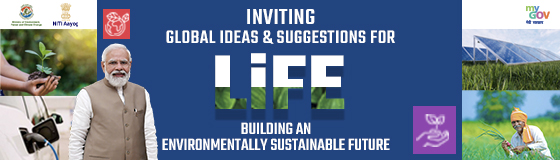
Inviting Global Ideas & Suggestions For LiFE - Building an Environmentally Sustainable Future

Inviting Global Ideas & Suggestions For LiFE - Building an Environmentally Sustainable Future
Start Date :
Jun 15, 2022
Last Date :
Jul 31, 2022
23:45 PM IST (GMT +5.30 Hrs)
Submission Closed

India is one of the leaders in sustainable development and clean energy. With the Hon PM Narendra Modi-led government’s reform-oriented, environment-friendly policies, the ...

India is one of the leaders in sustainable development and clean energy. With the Hon PM Narendra Modi-led government’s reform-oriented, environment-friendly policies, the country has time & again shown that sound environmental policies can pave the way to a sound economy.

At the UN Climate Change Conference COP26 in 2021, PM Shri Narendra Modi announced the ‘LiFE’, a mission to bring individual behavioural change at the forefront of the global climate action narrative. LIFE or Lifestyle for Environment along with the ‘Pro Planet People’ movement, aims to strengthen the efforts to overcome climate change.

LiFE will replace the prevailing 'use-and-throw’ thinking with an environmentally conscious lifestyle. The Mission is to create a global community of ‘Pro-Planet People’ (P3), who with their shared commitment will adopt and promote environmentally friendly lifestyles.

Individual Efforts Are Key to Climate Commitment

India's traditional knowledge strongly positions it to lead the narrative of addressing climate change. Like many other mass movements, LiFE aims to inspire climate action based on the mantra of ‘Sabka Sath, Sabka Vikas’.

MyGov invites you to share your ideas and suggestions on how to adapt to an environmentally conscious lifestyle.

1. Reduce
2. Reuse
3. Recycle
4. Renewable
5. Recover
6. Re-design
7. Re-manufacture

Few examples for the above:
Reduce - Electricity, Fuel Usage
Reuse - Old Clothes, Electronics, Building materials, furniture
Recycle - Plastic, newspapers, cartons, boxes
Renewable - Solar, Wind, Hydro, Tidal, Geothermal & Biomass
Recover - Forests, rivers, soil, mountains, wildlife
Redesign - Green buildings
Remanufacture - E-waste for new purposes

Our civilisational values have taught us the importance of living in harmony with nature. Today, let’s come together to protect our environment & take forward Mission LiFE - Lifestyle for Environment.

Reset
Showing 2859 Submission(s)
 Farvez Basha D
Farvez Basha D 3 years 11 months ago
Looked at as an approach, SD is an approach to development which uses resources in a way that allows them (the resources) to continue to exist for others (Mohieldin, 2017). Evers (2017) further relates the concept to the organizing principle for meeting human development goals while at the same time sustaining the ability of natural systems to provide the natural resources and ecosystem services upon which the economy and society depend. Considered from this angle, SD aims at achieving social progress, environmental equilibrium and economic growth (Gossling-Goidsmiths, 2018; Zhai & Chang, 2019). Exploring the demands of SD, Ukaga et al. (2011) emphasised the need to move away from harmful socio-economic activities and rather engage in activities with positive environmental, economic and social impacts.
 Farvez Basha D
Farvez Basha D 3 years 11 months ago
Acknowledging the pervasiveness of WCED’s definition, Cerin (2006) as well as Abubakar (2017) argues that SD is a core concept within global development policy and agenda. It provides a mechanism through which society can interact with the environment while not risking damaging the resource for the future. Thus, it is a development paradigm as well as concept that calls for improving living standards without jeopardising the earth’s ecosystems or causing environmental challenges such as deforestation and water and air pollution that can result in problems such as climate change and extinction of species (Benaim & Raftis, 2008; Browning & Rigolon, 2019).
 Farvez Basha D
Farvez Basha D 3 years 11 months ago
Sustainable development has become the buzzword in development discourse, having been associated with different definitions, meanings and interpretations. Taken literally, SD would simply mean “development that can be continued either indefinitely or for the given time period (Dernbach, 1998, 2003; Lele, 1991; Stoddart, 2011). Structurally, the concept can be seen as a phrase consisting of two words, “sustainable” and “development.” Just as each of the two words that combine to form the concept of SD, that is, “sustainable” and “development”, has been defined variously from various perspectives, the concept of SD has also been looked at from various angles, leading to a plethora of definitions of the concept. Although definitions abound with respect to SD, the most often cited definition of the concept is the one proposed by the Brundtland Commission Report (Schaefer & Crane, 2005). The Report defines SD as development that meets the needs of the current generation without compromising
 Farvez Basha D
Farvez Basha D 3 years 11 months ago
However, as argued by Mensah and Enu-Kwesi (2018), the definition must also emphasise the notion of cross-generational equity, which is clearly an important idea but poses difficulties, since future generations’ needs are neither easy to define nor determine. Based on the foregoing, contemporary theories of sustainability seek to prioritize and integrate social, environmental and economic models in addressing human challenges in a manner that will continually be beneficial to human (Hussain, Chaudhry, & Batool, 2014; UNSD, 2018b). In this regard, economic models seek to accumulate and use natural and financial capital sustainably; environmental models basically dwell on biodiversity and ecological integrity while social models seek to improve political, cultural, religious, health and educational systems, among others, to continually ensure human dignity and wellbeing (Acemoglu & Robinson, 2012; Evers 2018), and for that matter, sustainable development.
 Farvez Basha D
Farvez Basha D 3 years 11 months ago
Hák, Janoušková, and Moldan (2016) have argued that transforming global society, environment and economy to a sustainable one is one of the most uphill tasks confronting man today since it is to be done within the context of the planet’s carrying capacity. The World Bank (2017) continues that this calls for innovative approaches to managing realities. In furtherance of this argument, DESA-UN (2018) posits that the ultimate objective of the concept of sustainability, in essence, is to ensure appropriate alignment and equilibrium among society, economy and the environment in terms of the regenerative capacity of the planet’s life-supporting ecosystems. In the view of Gossling-Goidsmiths (2018), it is this dynamic alignment and equilibrium that must be the focus of a meaningful definition of sustainability.
 Farvez Basha D
Farvez Basha D 3 years 11 months ago
From this standpoint (Thomas, 2015) continues that sustainability brings into focus human activities and their ability to satisfy human needs and wants without depleting or exhausting the productive resources at their disposal. This, therefore, provokes thoughts on the manner in which people should lead their economic and social lives drawing on the available ecological resources for human development.
 Farvez Basha D
Farvez Basha D 3 years 11 months ago
Literally, sustainability means a capacity to maintain some entity, outcome or process over time (Basiago, 1999). However, in development literature, most academics, researchers and practitioners (Gray & Milne, 2013: Tjarve, & Zemīte, 2016; Mensah & Enu-Kwesi, 2018; Thomas, 2015) apply the concept to connote improving and sustaining a healthy economic, ecological and social system for human development. Stoddart (2011) defines sustainability as the efficient and equitable distribution of resources intra-generationally and inter-generationally with the operation of socio-economic activities within the confines of a finite ecosystem. Ben-Eli (2015), on the other hand, sees sustainability as a dynamic equilibrium in the process of interaction between the population and the carrying capacity of its environment such that the population develops to express its full potential without producing irreversible adverse effects on the carrying capacity of the environment upon which it depends
 Farvez Basha D
Farvez Basha D 3 years 11 months ago
Therefore, open and easy communication among nations has created grounds for cultural homogenisation, thereby creating a single global society (Waks, 2006). Political events no longer take local character but global character. Thus, according to Parjanadze (2009), globalisation is underpinned by political, economic, technological and socio-cultural factors and orientations. Although these developments theories have their weaknesses, they have paved the way for the current global development concepts and paradigm, namely “sustainability” and “sustainable development” (SD).
 Farvez Basha D
Farvez Basha D 3 years 11 months ago
Similar to the World System Theory, the Globalization Theory originates from the global mechanisms of deeper integration of economic transactions among the countries (Portes, 1992). However, apart from the economic ties, other key elements for development interpretation as far as globalisation is concerned are the cultural links among nations (Kaplan, 1993; Moore, 1993), In this cultural orientation, one of the cardinal factors is the increasing flexibility of technology to connect people around the world (Reyes, 2001).
 Farvez Basha D
Farvez Basha D 3 years 11 months ago
The World Systems Theory perceives the world economy as an international hierarchy of unequal relations (Reyes, 2001) and that the unequal relations in the exchange between the Third World and First World countries is the source of First World surplus. This contrasts with the classical Marxist Theory, which posits that the surplus results from the capital-labour relation that exists in “production” itself. (Bodenheimer, 1970; Reyes, 2001) The World System Theory has been criticised for overemphasising the world market while neglecting forces and relations of production. (Petras, 1981)