Home | MyGov

Accessibility
Accessibility Tools
Color Adjustment
Text Size
Navigation Adjustment
Screen Reader iconScreen Reader

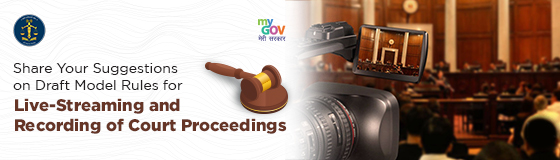
Share Your Suggestions on Draft Model Rules for Live-Streaming and Recording of Court Proceedings

Share Your Suggestions on Draft Model Rules for Live-Streaming and Recording of Court Proceedings
Start Date :
Jun 09, 2021
Last Date :
Jul 24, 2021
23:45 PM IST (GMT +5.30 Hrs)
Submission Closed

The e-Committee, Supreme Court of India envisages a judicial system that is more accessible, efficient, and equitable for every individual who engages with the justice delivery ...

The e-Committee, Supreme Court of India envisages a judicial system that is more accessible, efficient, and equitable for every individual who engages with the justice delivery system. The right of access to justice, guaranteed under Article 21 of the Constitution encompasses the right to access live court proceedings.

To imbue greater transparency, inclusivity and foster access to justice, the e-Committee has undertaken the project of live streaming of court proceedings on priority. This will enable access to live court proceedings, including on matters of public interest to citizens, journalists, civil society, academicians, and law students on a real-time basis, which was not otherwise possible owing to geographical, logistical, or infrastructural issues.

The e-Committee, Supreme Court of India invites inputs, feedback, and suggestions on the Draft Model Rules for Live-Streaming and Recording of Court Proceedings.

Click here to read the Draft Model Rules for Live-Streaming and Recording of Court Proceedings.

The last date to receive Suggestions/Inputs is 30th June 2021.

Reset
Showing 1793 Submission(s)
Pratham naik
Pratham naik 5 years 3 weeks ago
A good initiative. 21st century demands modernization and this step will increase the trust and confidence of citizens on judiciary. it will help young lawyers to learn about the court proceedings. even common man will be able to gain knowledge about the cases.
Ashoksingh
Ashoksingh 5 years 4 weeks ago
अभी मैं एक प्राइवेट कंपनी में जॉब कर रहा हूं और ये कंपनी न तो पीएफ हे न ही esi काट रही हैं सर ये कंपनी मे कुछ रूल तो होगा की यशा ही घर की तरह कंपनी चल रहा है यूपी मे जो आदमी काम करता है और आगे के लिए कुछ नहीं है सरकार ने कुछ रूल लगानी चाहिए
Pravin Kulkarni
Pravin Kulkarni 5 years 4 weeks ago
Main part of Live streaming and record of court proceedings shall include live telecast of judgment and the logic based on which judgement is arrived, evidence ignored and considered. PPT Presentation format shall be made available at the end of case/
moumita dutta
moumita dutta 5 years 4 weeks ago
Thanks for the opportunity. 1. Water tight recusal rules need of the hour for judiciary. 2. Unambiguous disclaimer on Conflict of Interest to be read out by every judge before taking up every hearing would immensely help in bringing about judicial accountability & leading by example. 3. PIL hearings to be mandatorily webcast, 4) our laws are too primitive, we need contemporary laws, universal civil code. Conflict of interest be made mandatory for MP, MLA, Bureaucracy too. Jai Hind!
Suraj agarwal
Suraj agarwal 5 years 4 weeks ago
Respected Prime Minister, I would like to drag your attention in the Tax slab when we Indian have intend to pay tax then there is a section which is called Hindu undivided family. In this section, if 4 members of the family earns lakh rupees each in a year then according to our so called Income Tax Department law it is been calculated as 4 lakh income as an Individual. why in Indian tax law Hindu undivided family income is been calculated as an individual why. that's why we separated.
DEVENDRA KUMAR
DEVENDRA KUMAR 5 years 4 weeks ago
Independence of judiciary Judiciary Supreme Court SC’s e-committee releases draft rules for live-streaming of court proceedings; invites inputs from stakeholders Live-streaming in certain cases may be restricted to final arguments, the draft rules say.
ARUN KUMAR GUPTA
ARUN KUMAR GUPTA 5 years 4 weeks ago
Can live streaming ensure fair trial as some people may expect? Ultimately judgement is to be given by the judge as per his own assessment of the case and not by what opinions media or other persons may have about the case. Aggrieved parties have rights to go to higher courts.